
Games Database
GameCube
Beat 'Em Up
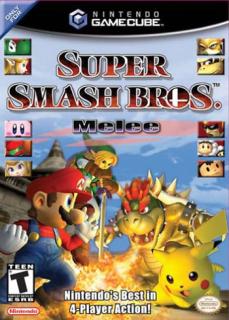
| Viewed: | 3D Third-person, floating camera | Genre: | Beat 'Em Up |
| Arcade origin: | No | ||
| Developer: | Nintendo | Soft. Co.: | Nintendo |
| Publishers: | Nintendo
(GB/GB) |
Released: | 11 Apr 2003
(GB) 24 May 2002 (GB) |
| Ratings: | 3+ | ||
| Accessories: | Memory Card | ||
Summary
Nintendo’s craziest and possibly most popular Japanese beat-em-up extravaganza debuted on the ill-fated Nintendo 64. It demonstrated instant playability (as with most Nintendo games), and quickly became an outright classic in its homeland and in the States. It’s success was somewhat limited in the UK, but the game’s sequel, Smash Bros. Melee on GameCube, is more widely anticipated on European shores, due to the game’s success elsewhere.
In all its Japanese-ness, Smash Bros. Melee is at heart, a simplified beat-em-up. Similar to Capcom’s own party fighting game Powerstone, players must choose from one of many famous Nintendo characters as they battle for supremacy in the Nintendo universe. You can choose to fight with mainstream heroes such as Mario or Link, or you can go for more obscure Nintendo characters such as the Ice Climbers.
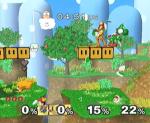
Once chosen, your character must fight against an onslaught of opposing Nintendo creations in any of dozens of renowned locations. But the most intriguing aspect of these fighting arenas is how they interact with the battle itself. Competing on an F-Zero circuit, for example, you suddenly find yourself hurled hundreds of metres down the track playing on a completely different layout. You must adjust your strategy accordingly. From the castle grounds of Peache’s all too familiar residence, to the deep caves of Super Metroid’s Brinstar, fighting against characters such as Giant Donkey Kong and Bowser can be quite intimidating. But all have their weaknesses, and finding them is only a matter of time.
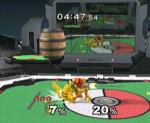
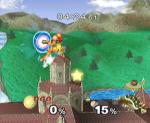
All characters have a standard set of attacks that can be put to use by tapping a direction and hitting a single attack button. The general goal within Smash Bros. Melee is simply to knock your opponent out of the fighting area. Each player has a damage percentage gauge at the bottom of the screen – the higher the level of damage, the more likely it is that you can knock them out of the area. The most predictable way to end a battle successfully is to deal significant damage first, then finish the opponent off with a special attack, blasting them out of the arena to the point of no return. Various power ups, such as Dr Mario tablets and Pokeballs, will help you deal more damage and gain a significant advantage, but the same applies to the enemy.
Smash Bros. Melee, as simple as it is to play, contains many intricacies that help it make more strategic and less of a button-bashing experience. The Japanese adore it, and it’s not hard to see why.
In all its Japanese-ness, Smash Bros. Melee is at heart, a simplified beat-em-up. Similar to Capcom’s own party fighting game Powerstone, players must choose from one of many famous Nintendo characters as they battle for supremacy in the Nintendo universe. You can choose to fight with mainstream heroes such as Mario or Link, or you can go for more obscure Nintendo characters such as the Ice Climbers.
Once chosen, your character must fight against an onslaught of opposing Nintendo creations in any of dozens of renowned locations. But the most intriguing aspect of these fighting arenas is how they interact with the battle itself. Competing on an F-Zero circuit, for example, you suddenly find yourself hurled hundreds of metres down the track playing on a completely different layout. You must adjust your strategy accordingly. From the castle grounds of Peache’s all too familiar residence, to the deep caves of Super Metroid’s Brinstar, fighting against characters such as Giant Donkey Kong and Bowser can be quite intimidating. But all have their weaknesses, and finding them is only a matter of time.
All characters have a standard set of attacks that can be put to use by tapping a direction and hitting a single attack button. The general goal within Smash Bros. Melee is simply to knock your opponent out of the fighting area. Each player has a damage percentage gauge at the bottom of the screen – the higher the level of damage, the more likely it is that you can knock them out of the area. The most predictable way to end a battle successfully is to deal significant damage first, then finish the opponent off with a special attack, blasting them out of the arena to the point of no return. Various power ups, such as Dr Mario tablets and Pokeballs, will help you deal more damage and gain a significant advantage, but the same applies to the enemy.
Smash Bros. Melee, as simple as it is to play, contains many intricacies that help it make more strategic and less of a button-bashing experience. The Japanese adore it, and it’s not hard to see why.


